





From Paper Checks to EFT: A Smarter Dental RCM Move
Why dental practices should consider moving insurance payments from paper checks to EFT
Paper checks have been part of dental insurance reimbursement for so long that most practices barely think about the process. A claim is processed, the payer mails a check, and someone at the practice deposits it. Simple, familiar, routine.
But as check fraud continues to rise across the United States, it is worth asking: is receiving thousands of dollars in insurance reimbursements through the mail still worth the risk?
Anyone handling dental billing knows that getting a claim approved is really just the first step. The money still has to actually reach your office, get posted to the right account, and balance out in your books. How that payment gets to you sits right at the center of all that work.
Check fraud is becoming a bigger concern
Check fraud isn't just a rare banking headache anymore. If you look at the Federal Reserve’s 2026 Risk Officer Report, 63% of the financial institutions they surveyed dealt with check-fraud attempts in just the last year. Actually, checks are now the second biggest target for fraud, right behind debit cards.
Breaking that down a bit: 32% of those institutions saw a jump in counterfeit checks, and 21% dealt with more check washing. FinCEN has even put out warnings specifically about check fraud tied to mail theft, and reports of suspicious activity have been climbing fast recently.
If your dental practice still depends on the mail to get a large chunk of your insurance payouts, these numbers are definitely something you should be paying attention to.
Dental practices are already moving toward EFT
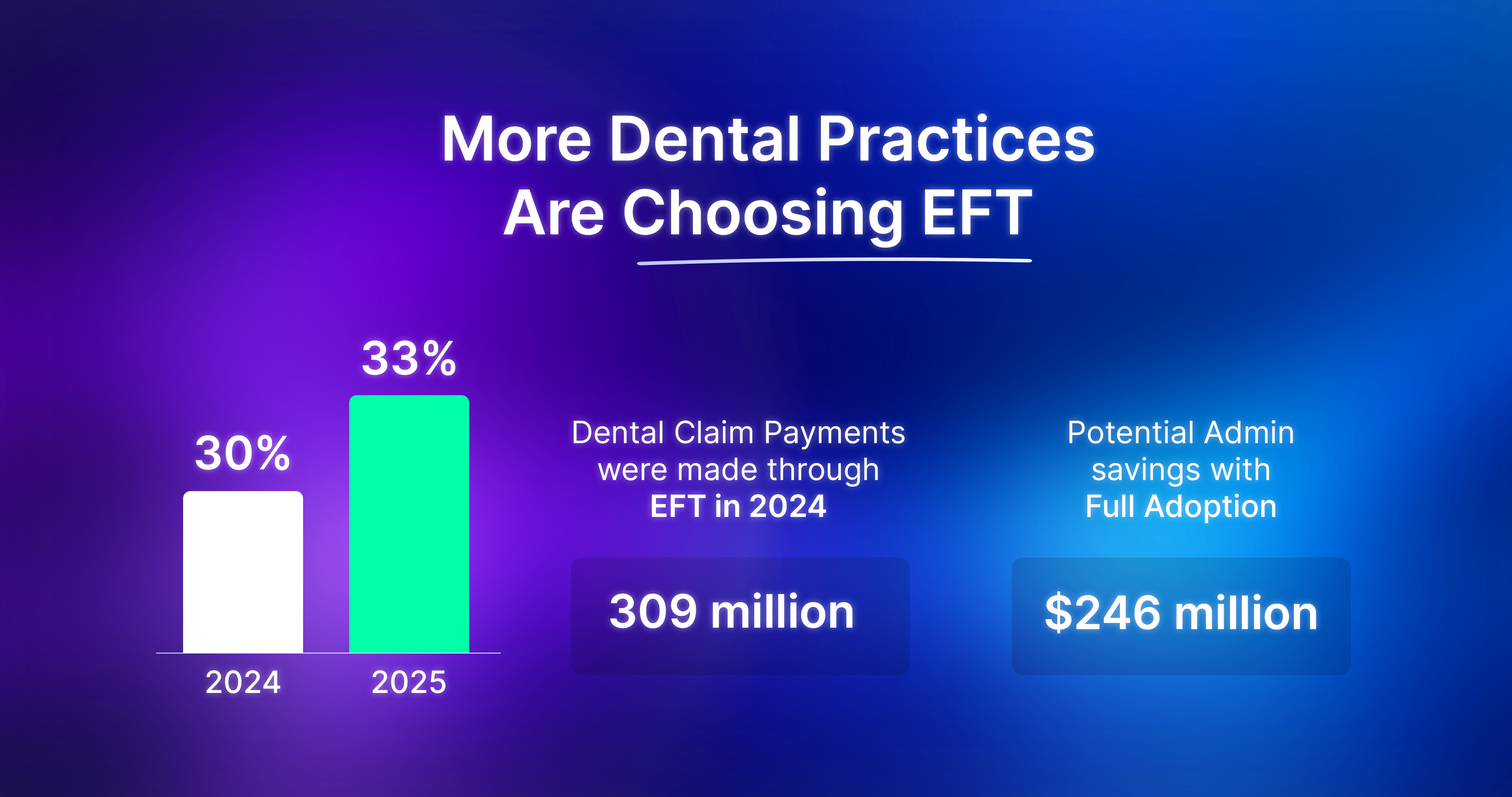
The shift is already happening. According to the 2025 CAQH Index, dental adoption of EFT for claim payments rose from 30% to 33%, and the industry could potentially save approximately $246 million in administrative costs if practices fully adopted EFT for claim payments.
| 30% → 33% Dental EFT adoption for claim payments | 309 million Dental claim payments made by EFT in 2024 | $246 million Potential admin savings with full adoption |
|---|
That 2024 figure is an 11.2% increase over the previous year, according to Nacha's summary of the report. Yet with adoption at only about one-third, there is still significant room to move away from paper-based insurance payments.
So the conversation is no longer just about convenience. It is about how securely payments move, how much manual work is involved, and how efficiently the revenue cycle runs. For teams managing dental RCM, the payment method is an important part of the overall workflow.
What could happen to a check before it reaches your practice?
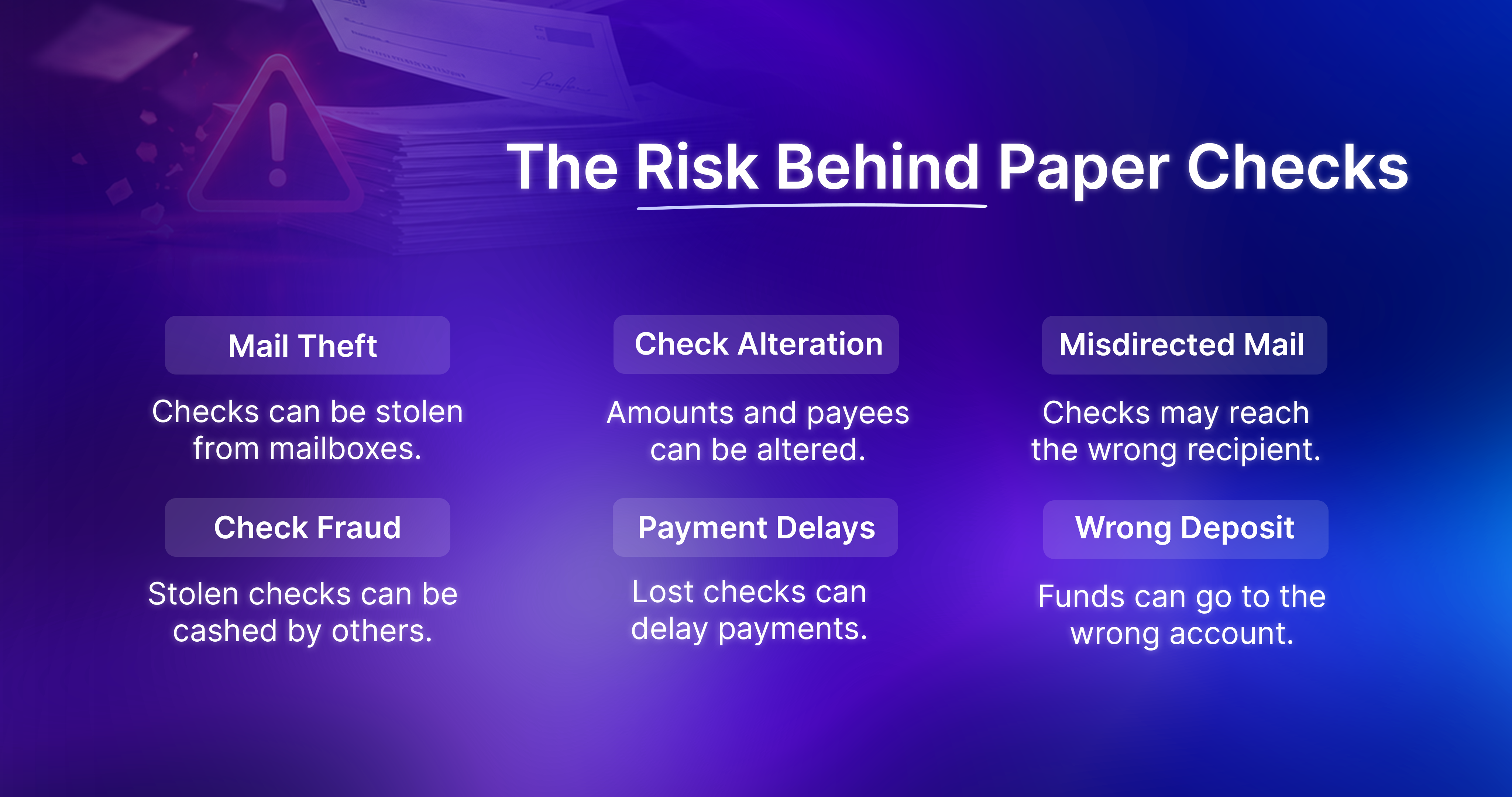
Consider a payer issuing a $20,000 insurance reimbursement. From the payer's perspective, the payment has been issued. But the money has not reached your practice yet. The check still has to travel through the mail before it can be deposited:
| Paper check | Payer → Check → Mail → Delivery → Dental practice → Deposit → Bank |
|---|
At several points along that journey, the check could be:
- Lost or stolen
- Misdelivered
- Altered
- Fraudulently endorsed
- Deposited into an unauthorized account
Take check washing, for example: a legitimate check can be intercepted and altered so the payment is redirected to someone else. Information taken from a genuine check can also be used to create a counterfeit one. The difficult part is timing. The team may not realize anything has happened until an expected payment never arrives, and by then the check may already have been deposited somewhere else.
| Is your practice still waiting on paper checks? Our RCM team can help you review payer payment methods and plan an EFT transition. |
|---|
When the payer says the claim was paid
Anyone working in dental RCM knows how frustrating this situation can become. The practice follows up on a claim it is still expecting payment for, and the payer responds:
"The claim was processed and the check was issued."
The practice checks its records and finds no payment, no deposit and no check. Now the team has to work out what happened. Was the check mailed to the right address? Was it lost, or deposited by someone else? Does the payer need to stop payment, reissue it, or ask the bank to investigate? What should have been a routine reimbursement has turned into an investigation, and the practice is still waiting for its money.
The cost of check fraud goes beyond the missing check
When a check disappears or is fraudulently deposited, the immediate concern is the money. But the disruption does not stop there. Practice staff or the dental revenue cycle management team may need to:
- Contact the payer and verify check details
- Research deposit information and request a copy of the cashed check
- Coordinate with the bank and initiate a fraud investigation
- Request a stop payment and payment reissuance
- Track the replacement payment and reconcile the account once resolved
A payment that should have needed very little attention can turn into days, sometimes weeks, of follow-up. For a team already managing claims, accounts receivable and payment posting, that is time pulled away from work that is still waiting to be done.
EFT removes the physical check from the payment journey
Electronic Funds Transfer, typically completed through ACH, takes a much more direct route. Instead of the paper path above, the payment moves like this:
| EFT | Payer → EFT → Practice bank account |
|---|
There is no paper check traveling through the postal system, none sitting in the office waiting to be deposited, none that can be washed or altered in transit, and no lost envelope containing thousands of dollars in practice revenue.
The ADA provides resources for practices considering EFT
The American Dental Association provides resources to help dental practices understand EFT implementation and electronic payment processes, including an EFT Implementation Checklist. These resources recognize EFT as an option practices can evaluate when deciding how to receive payer reimbursements.
At the same time, practices should retain appropriate choice over how they are paid and carefully review the terms of each payer's electronic-payment program. Moving to EFT should be an informed business decision, not something a practice accepts without understanding how the arrangement works.
EFT doesn't mean you can forget about security
Switching to EFT does not make fraud disappear. It changes the type of risk the practice needs to manage, and that means strong controls around banking information:
- Only specifically authorized people should request or approve changes to banking details.
- Verify any request to update banking information through a separate, trusted channel before making the change.
- Restrict access to bank accounts and monitor deposits and unusual activity.
- Ask your financial institution whether a dedicated account for insurance EFT deposits makes sense, and what additional controls are available.
EFT is not risk-free. The advantage is that it removes many of the physical vulnerabilities associated specifically with paper checks.
EFT and virtual credit cards are not the same
Not every electronic payment is an EFT. Some payers or payment vendors use Virtual Credit Cards (VCCs) instead, and those payments may come with merchant processing fees. If you are moving away from paper checks, it is worth asking the payer what payment options are actually available. Start with a simple question: “Can our payments be enrolled in ACH/EFT?”
Then find out:
- Are there any fees?
- Is a third-party payment vendor involved?
- Are there any optional services included with the enrollment?
It is better to know these details before enrolling. You want to know how the payment will arrive, whether there are any costs involved and who is handling the payment. This is also something to consider when evaluating dental insurance claims billing services. Getting the claim paid is important, but the way that payment reaches the practice can also affect the work involved and the overall cost.
Pair EFT with ERA for automatic payment posting
EFT moves the money. The electronic remittance advice (ERA, or 835) carries the payment details your team needs to post it. When the two are enrolled together, payments can be matched and posted with far less manual keying, which speeds up reconciliation and reduces posting errors. When you enroll a payer in EFT, ask about ERA at the same time.
Start with a simple exercise
You do not have to convert every payer at once. Start by reviewing the insurance checks your practice received over the last three to six months, and look at:
1. Which payers are still paying by check?
2. How many checks are you receiving every month?
3. How many dollars are arriving through those checks?
4. Which of those payers offer ACH/EFT?
Then look at where most of your paper-check revenue comes from. If five payers represent 70% of your paper-check reimbursement, convert those first, see how the change works in practice, and move on to the next group. It is a practical way to evaluate EFT without changing every payer relationship at once.
Don't wait for a fraudulent check to start the conversation
Think about a $20,000 insurance check for a moment. It is not just an envelope waiting to arrive at the office. It is $20,000 of practice revenue moving through the mail before it ever reaches the bank. The payer may have processed the claim correctly, your billing team may have done everything right, and your AR team may have followed up on time. But until the money reaches your bank account, the revenue cycle is not finished.
The dental industry is already moving toward EFT, and with adoption around one-third of claim payments there is real room to grow. So the next time your practice receives a large insurance check, ask: "Does this money really need to travel through the mail?" If your payer offers ACH/EFT, it may not.
Protect the final step of your dental revenue cycle
Getting a claim paid is important. Making sure that payment safely reaches your practice is equally important. Review your payer payment methods, identify where paper checks can be replaced with EFT, and put appropriate banking controls in place, before a missing or fraudulent check forces the change.
Build a more connected dental RCM workflow
Getting the payment is not the only part of the revenue cycle. A lot has already happened before that, including insurance verification and claims processing. After the payment comes in, there is still payment posting, reconciliation and AR follow-up. When these areas are not working together, it can take longer to find out where a problem started.
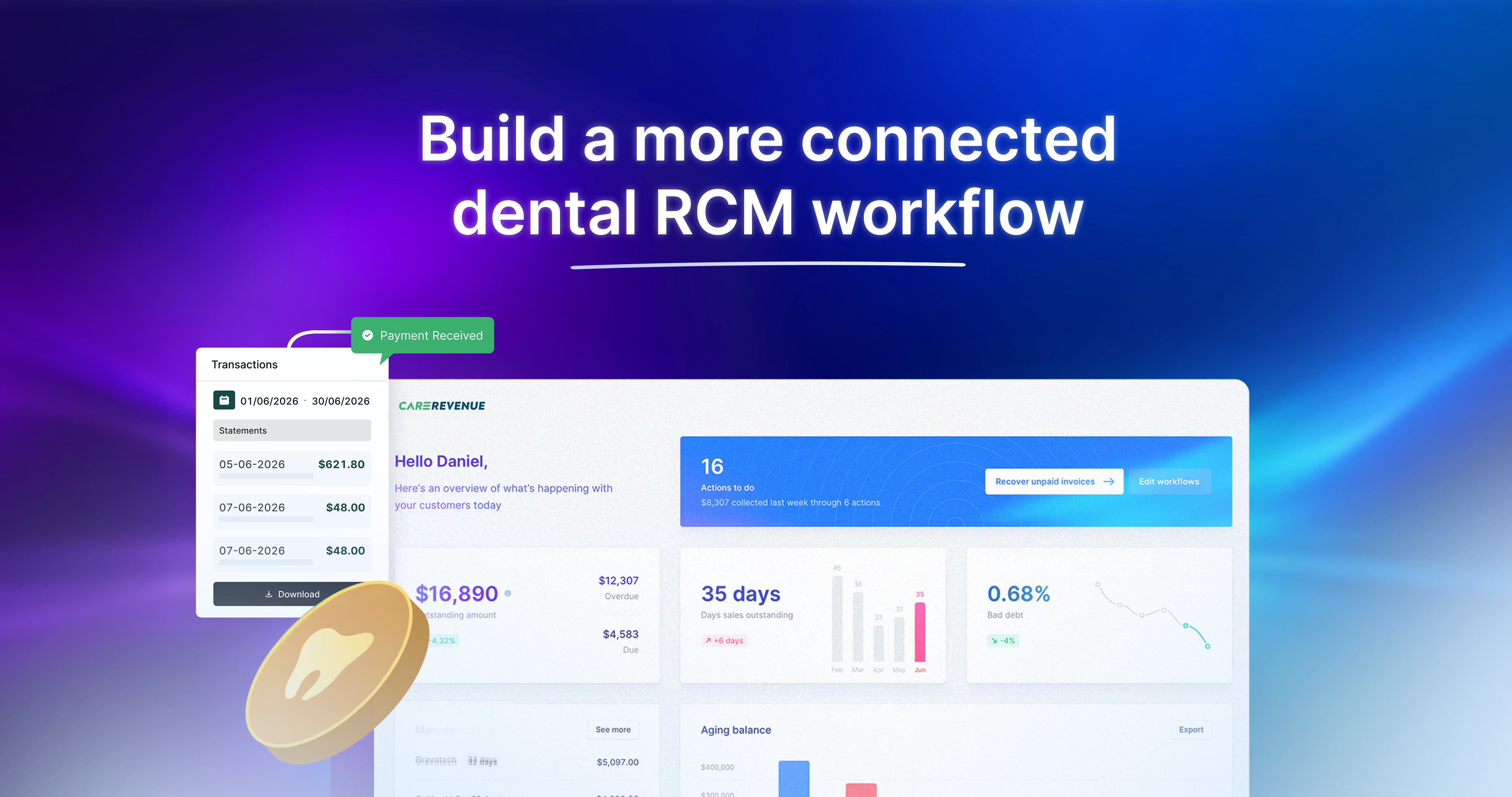
CareRevenue supports dental practices with these RCM processes, from claims and payments to follow-up. CareStack can also help practices keep their clinical, administrative and financial work in one place through its practice management platform.
Frequently asked questions
Q. Is EFT free for dental practices?
Enrolling in ACH/EFT with a payer is often free, but fees can apply when a third-party payment vendor is involved. Always ask the payer about fees and optional services before you enroll.
Q. What is the difference between EFT and a virtual credit card?
EFT deposits funds directly into your practice bank account through the ACH network. A virtual credit card is a card number the payer issues for each payment, and processing it may involve merchant fees.
Q. Can a dental practice decline virtual credit cards?
Practices can generally ask payers for ACH/EFT instead of VCC, though payer programs and state rules vary, so review the terms of each payer's program.
Q. What is an ERA (835), and why does it matter?
An electronic remittance advice is the electronic explanation of payment that accompanies a claim payment. Paired with EFT, it allows payments to post to patient accounts with less manual work.
| Move the money, not the paper. Talk to CareRevenue about dedicated RCM support across the full payment lifecycle. |
|---|
See Related Blogs
