





Dental Revenue Cycle Management: The Real Cost to Collect $1
Two dental practices each collect $1 million this year. On paper, they look identical. But one needs far more time, staff, and rework to get there.
That gap is the cost to collect. It’s the cost of the people, systems, and follow-up needed to turn completed treatment into cash. In dental revenue cycle management (RCM), total collections show what came in. The cost to collect shows what it took.
What Is the Cost to Collect in a Dental Practice?
Collecting money takes more than sending a claim. There’s insurance verification before treatment and claim preparation after it. Then come payment posting, denial follow-up, patient statements, and billing questions. All of that takes resources.
The cost to collect looks at those resources. It asks how efficiently the practice turns earned revenue into cash. It doesn’t replace collection rates, A/R days, or other financial metrics. It adds context to them.
Same $1 Million, Different Costs
Practice A has a streamlined billing process, accurate insurance information, and an organized A/R workflow. Avoidable claim issues are rare. Practice B spends hours each week correcting claims, checking unpaid accounts, and chasing missing information.
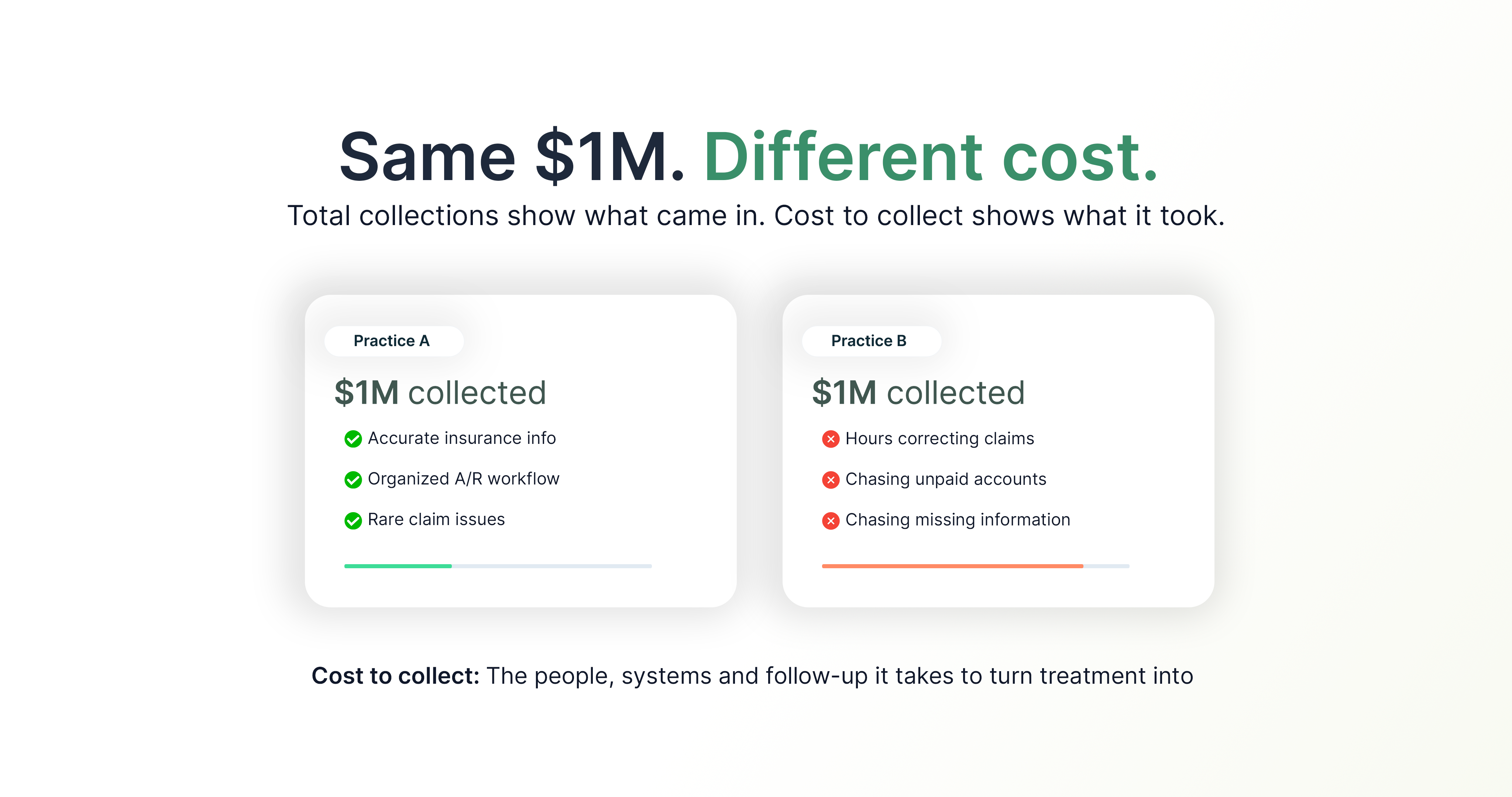
Both practices collected $1 million. They didn’t necessarily collect it at the same cost.
What Goes Into the Cost of Collecting a Dollar?
There’s no single formula for every practice. A team with in-house billing has a different cost structure than one using outside support. Still, most practices count some mix of these:
- Billing and A/R staff time
- Practice management and billing software
- Clearinghouse or claim submission fees
- Payment processing costs
- Patient statements and communication
- Denial and appeals work
- Insurance follow-up and payment posting
- Time spent resolving account issues
- Outsourced dental RCM services
Collection costs don’t begin when a payment arrives. They start much earlier in the revenue cycle. Some are easy to see, like salaries and software. Others hide in the workday, like time spent fixing errors that were avoidable.
Where the Hidden Costs Come From
A routine claim sounds simple. The patient is treated, the care is documented, the procedure is coded, and the claim goes out. That’s often just the start of the financial work. Someone has to watch the claim, answer payer requests, and review it if it’s denied. Multiply that across hundreds or thousands of dental claims, and small inefficiencies become real operating costs.

Rework
Rework rarely shows up as its own line item. A billing employee fixes a claim that went out with missing information. Someone checks why an insurance payment hasn’t arrived. Another person calls an insurance company about an account sitting in A/R. A patient calls because the statement doesn’t match what they expected to owe.
Each issue takes a few minutes. Across a whole practice, those minutes become hours. And when the same problem keeps coming back, the practice pays to fix it again and again.
Denials
A denial is more than a late payment. It creates a new task. Someone has to find out why the claim was denied, then check it against the clinical record, insurance information, CDT coding, or payer requirements. The claim may need to be corrected, resubmitted, or appealed, and then followed up again. The payment may still arrive, but it costs more to get.
That’s why denial management belongs in the economics of collection. A practice that prevents avoidable denials may need less administrative work to collect the same revenue. It may also see faster payment.
Aging A/R
An unpaid balance doesn’t necessarily get harder to collect overnight. But as accounts age, they take more attention. An insurance balance may need repeated payer contacts. A patient balance may need more statements. Older accounts also take longer to research, because the treatment may have happened months ago.
The longer an account sits, the more work it can attract. Good dental RCM isn’t only about getting paid. It’s about cutting unnecessary work between treatment and payment.
Can Technology and Staffing Lower the Cost?
Sometimes. But neither one fixes a broken process on its own.
The right systems can reduce manual work, streamline claims processing, and automate routine tasks. They can also give better visibility into A/R. Yet a practice can own several systems and still have fragmented workflows, with staff retyping data or tracking items in spreadsheets. The better question isn’t “How much technology do we have?” It’s “How much unnecessary work does it remove?” That’s a truer test of operational efficiency.
Staffing works the same way. Cutting administrative hours can look like savings. But if fewer people are available to follow up on claims, post payments, resolve denials, or work patient balances, delays follow. Those delays cost money too. Adding people to a broken process doesn’t help either, because they just work around the same errors. The goal is a dental revenue cycle that uses staff time where it matters most and leaves the team free to focus on patient care.
What Should Practice Leaders Measure?
Cost to collect works best next to other numbers:
- Total collections and cost of revenue cycle operations
- Cost to collect
- Clean claim performance
- Denial volume and denial reasons
- A/R aging and A/R days
- Payment posting turnaround
- Patient balance aging
- Staff time spent on billing and follow-up
You don’t need a complicated dashboard just to track numbers. Look for relationships instead. If the cost to collect goes up, ask what changed. Are claims needing more rework? Is the team spending more time on older A/R and denied claims? Are payment posting delays adding work? Did the practice add new payers or locations? Are patient billing questions increasing? The answers show where the process needs attention.
Don’t Chase the Lowest Possible Cost
Cost control isn’t the same as cost reduction. Some spending improves performance. Investing in accurate insurance verification often reduces claim denials and other downstream billing problems. Capable billing staff may improve follow-up. Effective technology may cut manual work. And experienced dental RCM services may bring specialized support that’s hard to build in-house.
The goal isn’t to spend as little as possible. It’s to spend wisely. A dollar spent on an effective process can pay off if it helps the practice collect more efficiently, improve cash flow, and avoid bigger costs later. Talk to our RCM expert
How to Lower Your Cost to Collect
Start with the problems that keep repeating. Look at the accounts that need attention again and again, then ask:
- Are the same claim errors showing up?
- Are certain payers creating more follow-up?
- Are payments sitting unposted?
- Are patient balances addressed too late?
- Are staff doing the same manual tasks every day?
Patterns show where the process is using up resources. Instead of asking someone to keep fixing the same problem, ask why it keeps reaching the billing team at all. Moving from fixing single accounts to improving the process is where real efficiency gains begin.
It’s also a team effort. Front-office staff verify insurance, handle patient scheduling, and help ensure patients understand what they owe. Clinical teams affect documentation and coding accuracy. Billing teams own claim submission and follow-up. A/R teams decide how quickly balances get worked. Technology connects them all. That makes collection efficiency a shared operational issue, and it shapes the practice’s financial success.
Final Takeaway
How much money you collect matters.. How you collect it matters just as much. When leaders know what it takes to collect—like the people involved, the systems used the processing costs, how follow-up is. How much rework happens—they can make smarter choices. They can decide where to invest, where to cut complexity and where the revenue cycle breaks down.
The best dental revenue cycles aren’t those with the teams, the newest tech or the lowest costs. They’re the ones where the right tasks happen at the time, where rework is minimal and where every step leads to faster payments and long-term financial health. That’s the opportunity in dental RCM. It’s not about getting more claims paid. It’s about getting the revenue paid—without all the extra effort, delays or mistakes along the way.
CareRevenue helps practices with claims management, payment posting, denial management and accounts receivable follow-up. Our dental RCM services help practices turn treatment into revenue—smoothly and consistently.
See Related Blogs
